If you're having trouble viewing this email, you cansee it online.
KAIMH Connections
Resources for Early Childhood Mental Health Advocates
Updates | July 2026
Read below for information on upcoming professional development opportunities, supporting brain development, the Child Care Modernization Act, Endorsement scholarships and more!
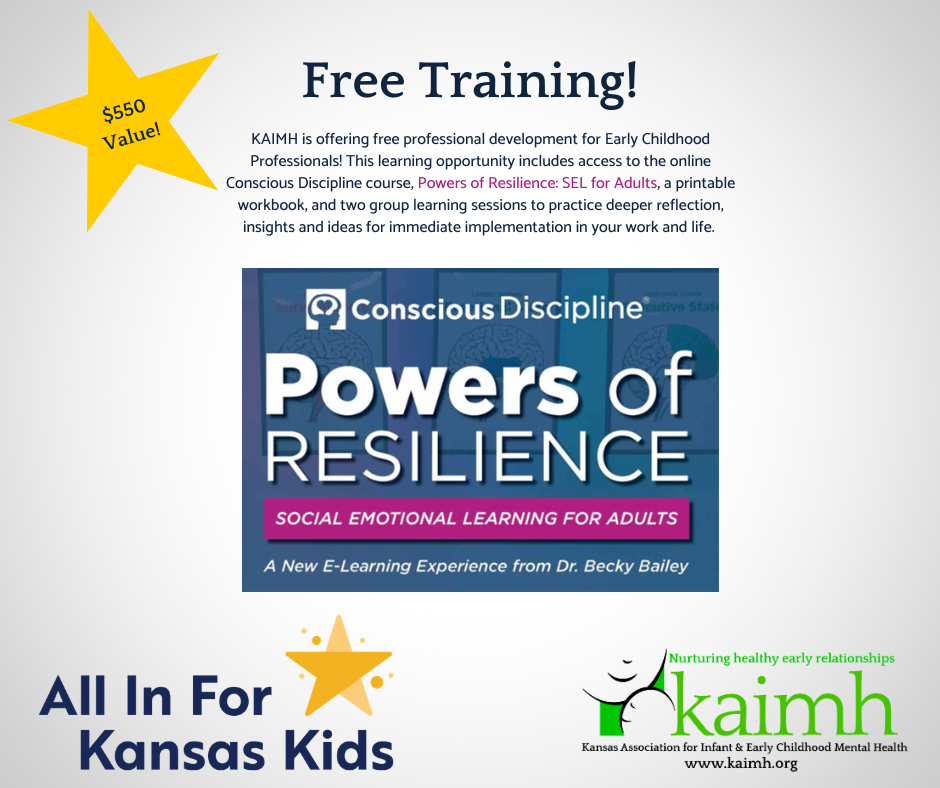
Free Conscious Discipline Training
KAIMH is offering a free professional development opportunity for Early Childhood Professionals! This includes access to the online Conscious Discipline course, Powers of Resilience: SEL for Adults, a printable workbook, and a 2-part group learning session to practice deeper reflection, insights and ideas for immediate implementation in your work and life.
Course Information:
Across 9 sessions, Dr. Becky Bailey leads video training on the Powers of Conscious Discipline, which are rooted in neuroscience and consciousness. The Seven Powers of Conscious Discipline help you develop your inner resources and create purposeful positive change in your life. Through this course, you’ll become aware of the mental models, limiting beliefs, unconscious biases and intentions that drive your feelings and behaviors. With consciousness comes the opportunity to choose differently and make lasting changes in your life and the lives you touch. In this e-course from Dr. Becky Bailey, you’ll learn how to live a life that reflects your values and vision, while creating the home or school culture and community that you truly want to see. In turn, you’ll pass healthy beliefs and behaviors on to future generations.
Access to the videos will open on July 13th and close September 15, 2026. For those interested, we will also offer 4 hours of state-approved in-service via two virtual learning sessions where we will review and reflect on the information in the video training. Those sessions are scheduled Tuesday, August 18th and Tuesday, September 15th from 6:30 - 8:30.
Seats are limited! To apply for access to the online training videos ($500 value) click the button below.
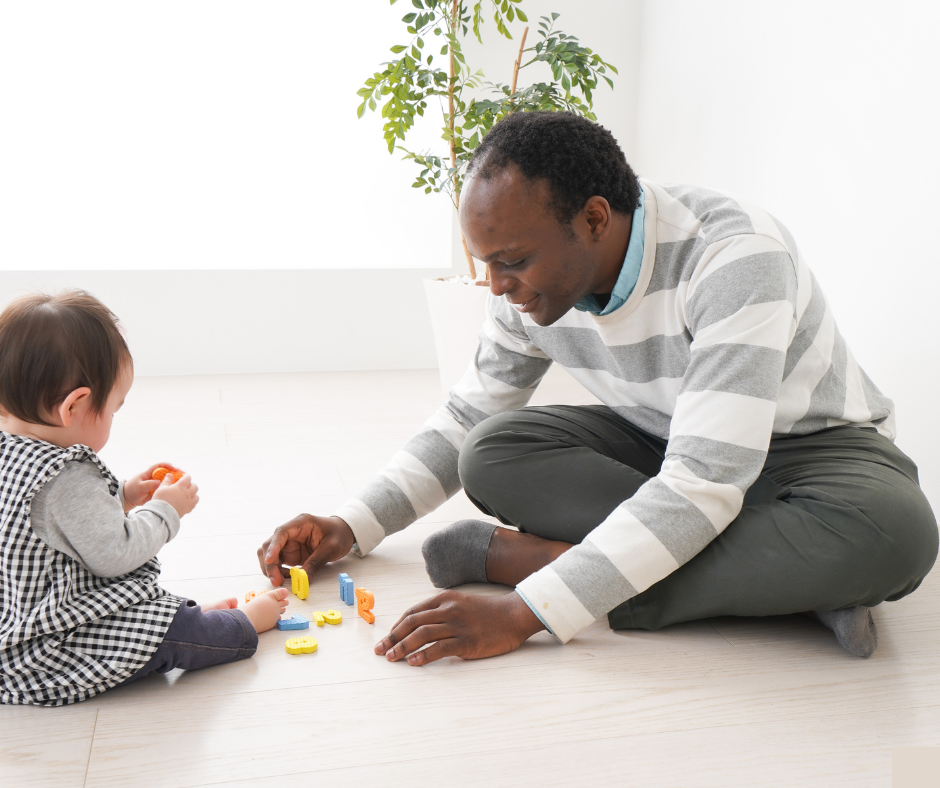
Developing Brains Through Experience, Not Through Protection
In a Psychology Today article by Timothy Cook M.Ed. he said, "The conversations about children and technology almost always start with restriction. Let's limit screen time, monitor apps, and set boundaries around AI. Those are reasonable steps but they are also the wrong unit of analysis. Restriction is not the same as construction. You can remove every screen from a child's life and still fail to build the conditions where thinking actually develops."
While caretakers are embracing the limitation of screen time and exposure to AI, there is also the need to grow children's critical thinking and problem-solving skills, starting in the early years. Sustained attention and social negotiation are learned through child-lead activities that also involve frustration tolerance and trial and error experiences. Cook says that in a culture that has redefined good parenting as the elimination of struggle, refraining from rescuing children from boredom and frustraton may be the hardest ask of all. To read more on this topic, click here.
Bipartisan Legislation to Improve Child Care Options for Families
The Child Care Modernization Act was introduced to the House of Representatives on June 9th. It is a bicameral, bipartisan legislation designed to strengthen the federal Child Care and Development Block Grant (CCDBG) program and better support the child care needs of working families across the country. The Act would help expand access to affordable, quality child care while also giving states greater flexibility to address the unique needs of their communities. The legislation focuses on targeted efforts to increase child care supply and capacity, support child care providers, and improve access for working families struggling with the high cost of care.
To learn more about the Child Care Modernization Act, click here.
Congratulations to Our Newest Endorsee!
Congratulations to Abby Thomason on receiving the Early Childhood Mental Health Specialist Endorsement! Abby says, "I have always been passionate about early childhood mental health and it’s an honor to work in a field where I can witness the change that occurs when support is provided to children and their families in these early years. I spent the first decade of my career providing early childhood mental health services in hospital, school, and home environments. In 2023, I opened my practice, Early Emotions, to provide specialized early childhood mental health services to parents, families, children, and schools in the Kansas City area. I am so grateful that this field continues to gain the attention it deserves and that organizations like KAIMH continue to advocate for these services and help bring providers together to support Kansas families."
Endorsement Scholarships
Did you know that the Infant/early Childhood Mental Health Endorsement® provides credibility for professionals engaged in the critical work of supporting infant & young children’s social-emotional and relational health & well-being? It is one of the first and most comprehensive efforts in the world to identify best practice competencies across disciplines and to offer a pathway for professional development. In addition to a professional’s background, I/ECMH-Endorsement® recognizes achievement of knowledge and training in the area of infant and early childhood mental health.
Ready to start or complete your Infant and/or Early Childhood Endorsement? Interested in a scholarship to cover your fees?
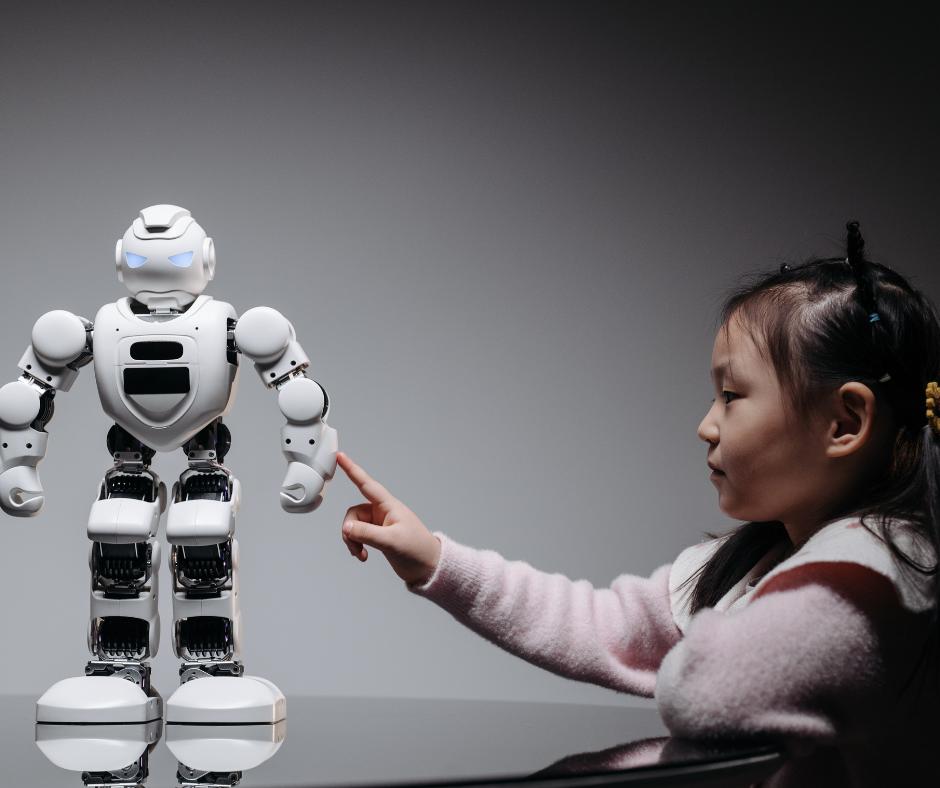
Infants, Toddlers, Artificial Intelligence, Mental Health, and Justice
Submitted by Rich Minder, Race and Social Justice Committee Member
This KAIMH Newsletter column highlights emerging topics and trends relevant to infant and early childhood development. Articles are written or summarized by members of the Race and Social Justice Committee to encourage reflection and discussion among KAIMH members. As artificial intelligence becomes increasingly integrated into daily life, it raises important questions about relationships, caregiving, equity, and justice. This article invites us to consider these issues through the lens of infant mental health, recognizing that healthy development occurs within relationships and that equity and justice must guide our response to emerging technologies.
Artificial Intelligence seems to be everywhere these days. AI answers phones, helps us write email messages, school papers, business correspondence, etc. Yet AI seems to open a wider and wider chasm between the work of infant mental health in classrooms, therapy sessions, and home visits. One wonders what impact growing presence of these non-organic forms of intelligence might have on child development as humans enter an age in which we share decision making with beings that can think millions of times faster than humans, incorporate vastly more data points, using information processes that humans can no longer understand or control.
Will AI robots provide caring work? Will human caregiving gain new insights on diagnosing and treatment planning from AI? Will practitioners turn to AI for real time coaching in home visiting and classrooms? How will infants and toddlers relate to AI Bots?
This brief article is intended to consider these questions through lenses of racial and social justice. First, we present some key definitions of terms that will help frame this inquiry. Then we revisit these questions to open a community discussion about the racial and social justice implications of human relationships with non-organic intelligence.
Some Definitions Infant Mental Health An infant’s capacity to experience, regulate, and express emotions; to form close and secure relationships; and to explore and learn from their environment. Learning 1. A change in understanding or ability. At its core, learning is a lasting change in knowledge, skills, or understanding. Something becomes possible, clearer, or more refined that wasn’t before. 2. The process of updating internal models. Across psychology, neuroscience, and even AI, learning is often described as the updating of internal representations—the mental models we use to interpret the world and act within it.
Information is meaningful content—facts, signals, or patterns—that, when interpreted, reduce uncertainty and expand understanding. Intelligence is the capacity to learn, understand, and reason; to adapt to new or complex situations; and to apply knowledge in ways that solve problems and support effective action. Artificial Intelligence AI is the capability of machines to perform tasks that normally require human intelligence—such as learning, reasoning, perception, and decision‑making — enabled by computational methods that allow systems to adapt, infer, and act. Artificial General Intelligence AGI refers to a machine intelligence capable of understanding, learning, and applying knowledge across the full range of tasks that humans can perform. Unlike today’s narrow AI systems, which excel only in specific domains, AGI would be able to generalize across contexts. Artificial Super Intelligence ASI is a hypothetical form of AI whose cognitive abilities surpass human intelligence in every domain—scientific, creative, social, and strategic—representing a level of machine capability far beyond anything that exists today. Justice is the enduring commitment to fairness—ensuring that individuals receive what they are due, that laws are applied impartially, and that moral and social relationships are governed by equity.
Synthesis Infants and toddlers and non-organic intelligence both develop by incorporating data and information. Human and non-organic intelligence both learn. Infants and toddlers and non-organic intelligence grow in ways that are dependent on the data and information “fed”.
At this point, non-organic intelligence is trained on data sets provided by humans. As these non-organic intelligence beings develop independently, they will access information independently. Indeed, they will begin independently to formulate new information, new myths, new stories. They will likely partner with humans in a wide variety of ways, including our social and emotional well-being if not become overlords to determine the social, economic, political and emotional contexts in which humans survive or perish.
Some Questions • Can an inorganic intelligence entity, through machine learning, exceed human intelligence in performing caring functions equitably? • Do humans benefit more from caring for others or from being cared for? Do inorganic intelligent beings benefit more from caring for others or being cared for? • Is caring for infants and toddlers a skill that can be off-loaded to inorganic intelligent beings? • In what ways might the quality of caring by an autonomous, artificial super intelligent being exceed the quality of caring provided by humans? • If inorganic intelligent beings grow and develop by learning from and being trained on human constructed databases, should these beings be “fed” the full range of good, bad, biased, and dangerous data and information? Is there any way to prevent these beings from digesting this data without ethical guardrails to ensure human values of equity? What role(s) and responsibilities do human infant mental health professionals have to monitor and shape the growth and development of inorganic intelligent beings? • How can infant mental health professionals best care for families who are fed information from inorganic intelligent beings?
July - August Professional Development
Check out these upcoming professional development opportunities that support your Infant & Early Childhood Mental Health Endorsement® from the Early Childhood Investigations Webinars, Kansas Child Care Training Opportunities, Rainbows United, Kansas Children's Service League, and Child Care Aware network and KAIMH.



.jpg)