If you're having trouble viewing this email, you cansee it online.
KAIMH Connections
Resources for Early Childhood Mental Health Advocates
Updates | January 2026
Read below for KAIMH conference registration information, the value of independent play in early learning classrooms, information on attachment, free resources, upcoming professional development and more!
I/ECMH Endorsement Renewal
This is a friendly reminder that KAIMH membership is on an annual cycle and Endorsement®is on an every three-year cycle (2027, 2030), with a renewal window (Oct-Dec) for attesting to the past three years' requirements. You can log into your EASy account anytime after your initial endorsement and update your application with your continuing professional development and reflective supervision hours. The "renewal" button will only be visible October-December during the renewal period starting in 2027. During the renewal period, you can log into EASy to attest (confirm) you met all requirements for the preceding years. Some renewals are randomly audited, so diligent record-keeping in EASy (or on your own) is crucial. We recognize a three year payment cycle may not fit some budgets that run yearly, so we have made payment options. When logging into your membership portfolio you have two payment options: you can pay for your annual membership ($40) and yearly Endorsement Fee ($35.00) for a total of $75.00 yearly; or you can pay only your membership ($40.00) and in the 2027 renewal period pay the full Endorsement renewal fee of ($105.00) through an invoice sent by us. If you have questions please reach out to beth@kaimh.org.
Become a member of KAIMH and save $50 off your conference registration. KAIMH Conference Pricing is $325 for both days, including meals, snacks and evening entertainment! KAIMH Members receive a discounted registration of $275. Save an additional $25 with Early Bird Pricing until March 1, 2026. Click here to register.
Interested in applying for a scholarship?If you are a professional working in a licensed child care facility, KCCTO (Kansas Child Care Training Opportunities) has limited funding for scholarships to cover registration and travel fees for state conference training. Apply here.
KAIMH has limited conference scholarships funded through the Preschool Development Grant to cover registration fees. To apply click here.
Call for Breakout Presentations
KAIMH invites infant and early childhood mental health advocates and professionals to submit proposals for breakout sessions at our 2026 Annual Conference, April 23-24 in Wichita, Kansas. This year’s theme, “RESILIENCE: Building Children’s Capacity to Bounce Back” with keynote speaker, Nicki Patton Rowe, challenges us to strengthen our approach and collective impact as we support young children and their families. We are seeking dynamic, engaging presentations that highlight adult and child resilience through promotion, prevention and intervention. Proposals can include:
• Strategies for building skills across transdisciplinary teams • Peer-to-peer learning experiences that strengthen infant and early childhood mental health knowledge and collaboration • Engaging presentations on refl
ective and inclusionary practices
Breakout sessions are 1.5 hours in length. We welcome proposals for one or two-part (3 hr) options. Sessions that offer actionable takeaways and build skills applicable across disciplines will be especially valued. One free conference registration is offered per session, so if you are the sole presenter you are welcome to attend the conference for free. If you are co-presenting we can offer one free conference registration, or two if you present a two-part session.
Conference Details: Concurrent Sessions and Vendor displays: April 23-24, 2026 Proposal Submission Deadline: January 18, 2026 Help us to impact resilience and inspire change to shape the future of young children’s lives. Submit your proposal today!
Vendor Opportunity: We also invite professionals and agencies to participate by having a resource table to showcase your programs, tools, research, and services to colleagues across Kansas. Vendor tables will be located in the main presentation room. Click here to learn more and register for a table.
15 Daily Learnng Games for Children 0-3
The Michigan Department of Lifelong Education, Advancement and Potential has put together a resource of 15 games that cover the four development domains for early learning moments with children from birth to age 3. The activities aim to be simple but effective in supporting positive relationships, speech and communication, thinking skills, social skills and emotional knowledge. To download this document, click below.
Dr. Mona Amin, from Peds Doc Talk podcast, says parents and caregivers need just as much care and attention as children do — because when a child is born, so is a parent. Her website shares parenting guidance rooted in science, psychology, and child development and includes a library of infant and toddler resources you can download for free. Subjects include no-pressure potty learning, regulating through children's tantrums, newborn sleep tips, fussy baby checklist and more. Check out the resource section here!
From the KAIMH Race & Social Justice Committee: Attachment in Context
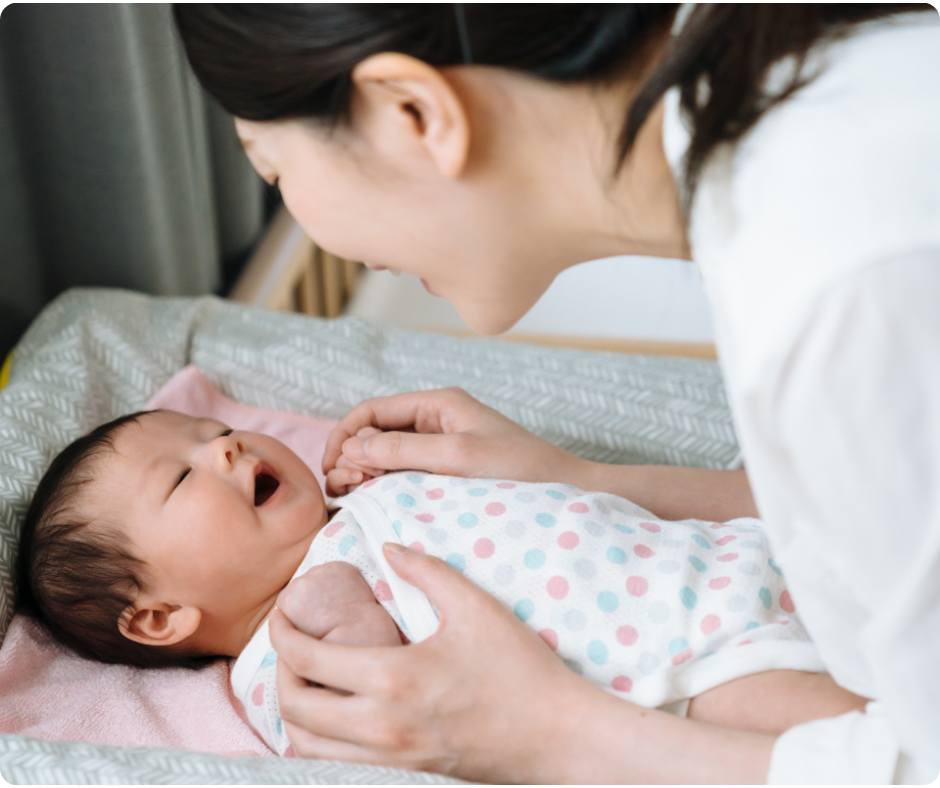
The bonds formed early in the infant/caregiver relationship can be described as either secure (comfort provided by a consistent caregiver), insecure (lack of comfort due to an unavailable caregiver) or disorganized, which is a mix, often from trauma, where the caregiver is both a source of fear and comfort. Early attachment creates an "emotional blueprint" that shapes adult relationships, influencing trust, intimacy, communication, and conflict resolution. Secure attachments in infancy foster healthy, balanced connections later in life, while insecure styles (anxious, avoidant, disorganized) can lead to difficulties like fear of abandonment, emotional distance, or relationship instability. These patterns, learned in childhood can repeat in adult partnerships, friendships, and parenting, affecting self-esteem and overall mental health. To learn more, check out this article submitted by Tiffany Bartley B.A. IMH-E.
Balanced Play Experiences in Early Learning Classrooms
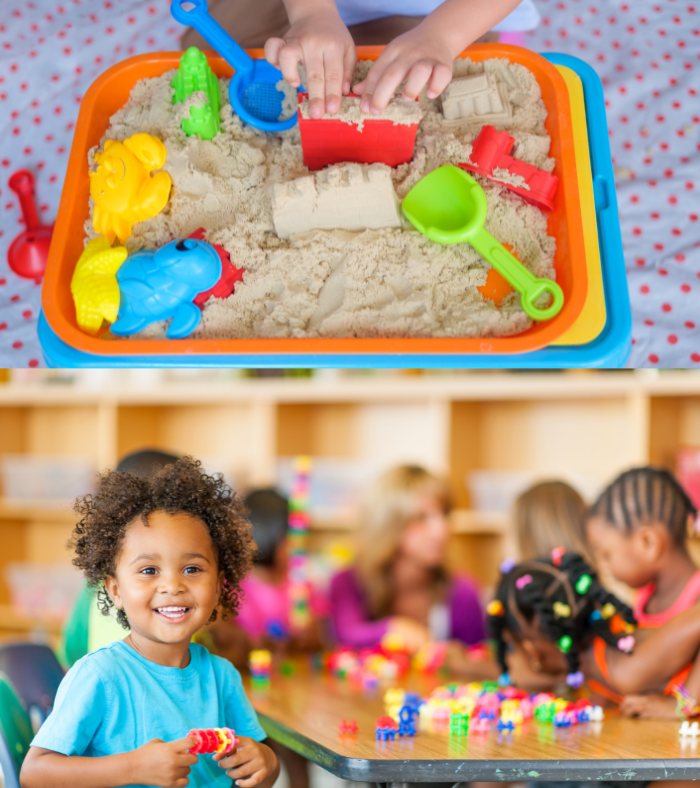
Group child care offers social/emotional benefits to children in the early years particularly in giving them many opportunities to practice social skills with peers that they may not be able to experience in their home environment. Along with these enriching experiences we also need to keep in mind that too many of these interactions can also be overwhelming to their nervous systems and lead to behaviors that can be challenging. A high quality early education classroom will provide opportunities for children to play independently or in a small group so children can take a break from the stress of whole group interactions. During these colder months when "cabin fever" sets in it is a good time to reflect on your daily schedule and see if children are being transitioned from one whole group activity to the next or if there are social breaks built in, allowing for children to have down time to reset their nervous systems.
It can be helpful to use a tray to designate an independent play space at a table, or a carpet square can be used to designate space on the floor. This gives the other children the visual cue to see that their friend is wanting to play alone. Research also shows that having a "micro-retreat" space where children can go to support their self-regulation is also a helpful tool in supporting their mental health - such as a "safe place" or "calming corner." It is important that children are not sent to these emotion regulation spaces as punishment, but instead offered as a space to go if they need some mindful mental rest time.
Independent play opportunities can include active areas for jumping and climbing as well as quiet zones for reading, drawing or daydreaming. Providing children options, such as sensory materials or rhythmic movement, allows them to choose an activity that matches their current sensory needs.
Check out these upcoming professional development opportunities that support your Infant Mental Health Endorsement® from the Early Childhood Investigations Webinars, Kansas Child Care Training Opportunities, Kansas LEND, Kansas Children's Service League, and Child Care Aware network.


.png)